3D Bubble Shoot - ASMR Game
TaTa Game Technology LimitedCasual
4.92.62K Reviews
- Version
- 25.0
- Installs
- 5.00M
- Age Rating
- Everyone
Screenshots
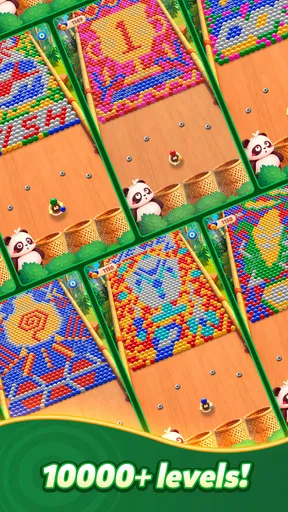
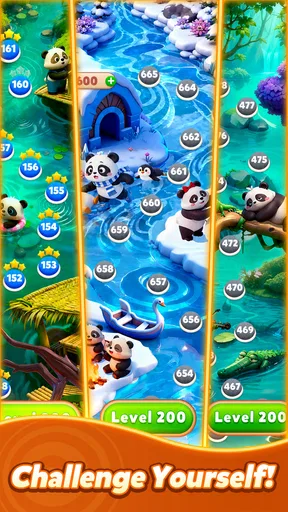
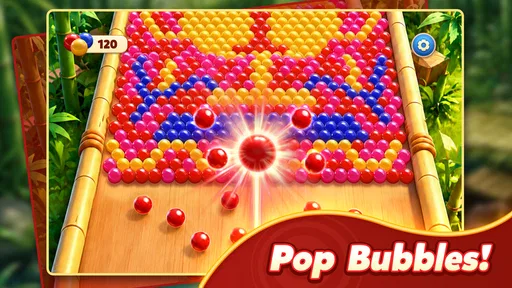
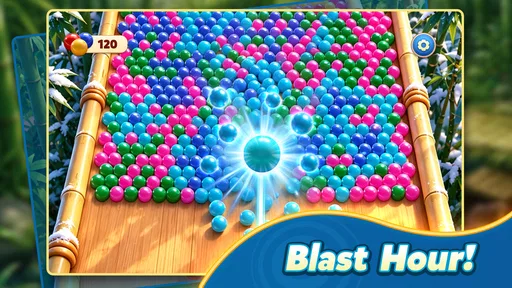
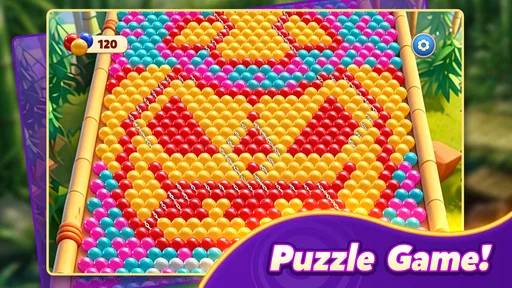
Our Review of 3D Bubble Shoot - ASMR Game
 Analysis by Appyee
I went into 3D Bubble Shoot - ASMR Game expecting a simple time-filler, and that is exactly where it works best. This is a casual physics bubble shooter from TaTa Game Technology Limited, built around a very clear action: aim, release, watch the orbs react, and decide whether the result deserves another shot. The appeal is not a complicated story or a large collection of systems. It is the small satisfaction of making one accurate move and seeing the board respond.
The game is free to start, carries an Everyone age rating, and runs on Android devices using version 6.0 or later. Its current version is 25.0, while the store lists a 4.9 average from around 139 thousand ratings and more than 5 million installs. Those figures suggest that the straightforward format has found a broad audience, but they do not change the central question: is the moment-to-moment play enjoyable enough to keep returning to? In my experience, the answer is yes, provided you want a relaxed shooter rather than a deep puzzle game.
How the shot becomes the whole experience
I find that the fun starts before the bubbles move: I have to read the arrangement and decide what kind of reaction I want, rather than simply aim at the nearest match. That makes each shot a small prediction, and it gives the physics a purpose beyond decoration. Next, I look at what the current version and release details can—and cannot—tell returning players about how the game has changed.
The first action is easy to understand
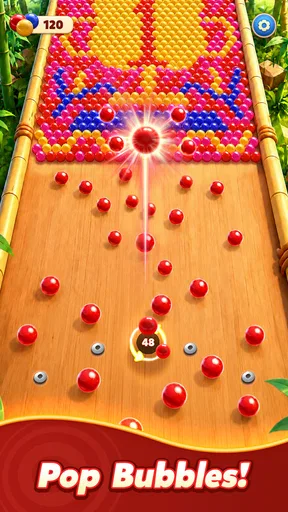
The opening move is deliberately familiar. I look at the arrangement of colored bubbles, choose a direction, and fire. The 3D presentation gives the shot more physical presence than a flat matching game, because I am not merely selecting a target from a grid. I am judging an angle and imagining how the projectile will travel through the space in front of me.
That difference matters. A conventional bubble shooter often feels like a board-management exercise, with the main concern being color matching. Here, the physics layer makes the same basic idea feel more tactile. A shot can connect with a group, disturb the structure, and send several orbs downward. The best moments come when the first contact produces a larger reaction than I expected.
I also like that the basic control does not require a tutorial-heavy commitment. Someone picking up the game during a short break can understand the objective almost immediately. That makes it suitable for casual players who do not want to learn a complicated control scheme before having fun. It is also approachable for younger players, although an adult should still consider the optional purchases before handing over a device.
The simplicity has a trade-off. If you are looking for a campaign with a strong narrative, character development, or a large strategic rule set, this is not that kind of game. Its identity is concentrated in aiming and watching the resulting cascade. The lack of extra layers is a strength during a five-minute session, but it can become a limitation for anyone who needs constant novelty.
Why the physics changes the familiar formula
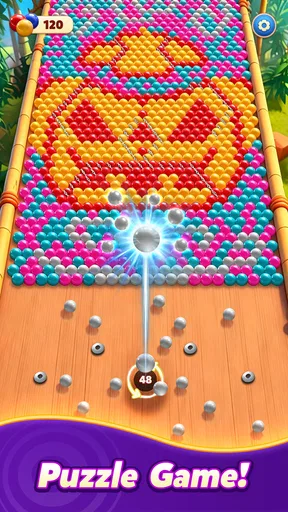
The most important distinction is the relationship between precision and consequence. In a basic match-three shooter, a correct color choice may be enough. In this game, the angle of the shot affects how the bubbles collide and fall, so I pay closer attention to the route rather than firing only at the most obvious cluster.
That creates a useful habit: before shooting, I pause long enough to identify the group that will make the biggest section unstable. The tempting move is often to hit the nearest matching area. A better move can be to make contact with a supporting point, allowing the connected orbs above it to drop. This is one of the less obvious pleasures of the game, because the reward comes from understanding the structure rather than simply reacting quickly.
Another practical tip is to treat the edges as tools instead of obstacles. When a direct line does not look promising, a banked shot may give the projectile a more useful path. I do not approach every turn as a perfect calculation, but using the side of the play area deliberately makes the game feel more skill-based. It also reduces the frustration of wasting shots on a group that looks close but is not actually vulnerable.
The physics are not intended to create a realistic simulation. They serve a visual and emotional purpose: they make a successful shot feel heavier, more active, and more rewarding. That is why the game can remain entertaining even when the underlying goal is familiar. The pleasure is in seeing a decision become motion.
The feedback rhythm keeps attention moving
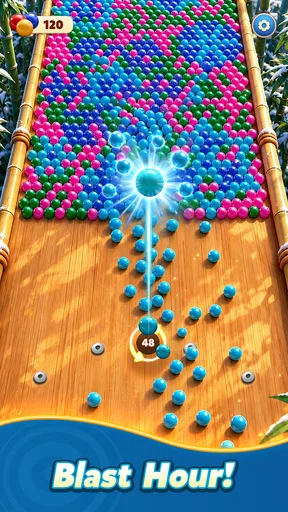
After the shot, the game gives me a short feedback cycle. There is the initial impact, the movement of connected orbs, and the larger cascade when the arrangement gives way. The store describes this as an ASMR-like experience, and that description fits the intended mood: the falling motion and layered reactions are meant to be soothing as well as satisfying.
What works here is the rhythm between control and release. I make a decision, then briefly stop controlling the action while the result plays out. That pause is important. If the game immediately demanded another input with no visible consequence, the shooting would feel mechanical. Instead, the falling bubbles create a small moment of anticipation: I want to see whether the reaction stops early or continues farther than expected.
This makes the game particularly comfortable for low-pressure play. I can use it when I want something more interactive than watching a video but less demanding than a competitive action game. A realistic everyday scenario would be waiting for an appointment or sitting on a train with a few spare minutes. I can play one short sequence, enjoy the cascade, and put the phone away without needing to remember a complex plot or coordinate with other players.
There is also a concentration benefit, although I would not call it a serious brain-training tool. The best shots ask me to slow down, inspect the arrangement, and predict a physical reaction. That is a modest form of visual planning. Still, the game should be judged as entertainment first. It does not replace a dedicated puzzle title for players who want increasingly elaborate logic challenges.
When the feedback is satisfying and when it is not
The cascade is strongest when the shot creates a clear chain reaction. Those moments give the game its personality and explain why the loop can be more compelling than ordinary color matching. I enjoy the contrast between a quiet aiming phase and a sudden burst of movement. The result feels earned because the visual payoff follows a decision I made.
On the other hand, a weak shot can expose the limits of the format. If the contact produces little movement, the turn may feel anticlimactic. That is not necessarily a design failure; physics-based play naturally includes less successful outcomes. But players who want every action to deliver a dramatic reward may find the quieter results disappointing.
My advice is to avoid firing as quickly as possible. The game becomes more enjoyable when I use the aiming phase to search for a setup rather than treating each turn as a reflex test. I look for suspended groups, narrow openings, and places where one connection might remove support. This approach produces more of the satisfying cascades and also gives the simple mechanics a little more depth.
The reward is the visible result, not a complicated progression system
In this experience, the immediate reward is the board changing in a pleasing way. Orbs fall, space opens, and a carefully chosen shot can solve more of the arrangement than a random attempt. That direct connection between action and result is easy to appreciate. I do not need to wait for a long sequence of menus before knowing whether I played well.
The reward also has a sensory side. The falling motion is the reason the ASMR angle makes sense, but I would describe it as visual satisfaction rather than a complete relaxation product. If you enjoy watching objects tumble in a controlled chain, the presentation adds real value. If you dislike repetitive sound or visual effects, the same emphasis may feel less appealing over longer sessions.
There is a useful distinction between a good result and a lucky result. A large cascade can happen because the board was favorably arranged, but I get more lasting enjoyment when I can explain why the shot worked. That is where the game moves beyond a passive animation: I begin to recognize support points and plan around the likely fall. The reward becomes a small lesson in the board’s physical behavior.
The free entry point is another practical advantage. I can try the core loop without paying first, which is important for a game whose appeal depends heavily on whether its visual feedback suits my taste. In-app purchases range from $1.99 to $99.99 per item, so I would keep spending controls in mind, especially on a shared device. The game may be perfectly enjoyable as a free download, but the presence of optional purchases means I would not let a child use a payment-enabled account without supervision.
How it compares with ordinary casual alternatives
Compared with a standard flat bubble shooter, this game is more about impact and movement. A traditional alternative may be better for someone who wants a cleaner, more predictable puzzle board where color combinations are the main concern. The 3D physics approach is better for someone who wants the shot itself to feel expressive and enjoys watching the result unfold.
It also differs from match-three games that rely on swapping tiles. In a swap-based game, I usually inspect several possible combinations before making one move. Here, my attention is directed toward trajectory, contact, and structural collapse. That makes the experience more immediate, but it may offer less variety in decision types.
Against endless runners or fast arcade games, the pace is much calmer. There is no need to memorize a route or react continuously. That makes it a good choice for a short mental reset, but not for someone seeking adrenaline or a strong sense of personal mastery through speed. Against deep puzzle games, it gives up complexity in exchange for a more satisfying physical response.
The right comparison, then, is not whether it has more content than every other casual game. It is whether you prefer a simple decision followed by a pleasing chain reaction. If that pattern sounds rewarding, the physics layer gives this bubble shooter a clear reason to exist.
The session reset is part of the appeal
One reason I can return to the game easily is that each attempt feels self-contained. I do not need a long warm-up before the first shot, and a disappointing result does not ruin a larger narrative investment. I can finish a sequence, assess what happened, and begin again with a slightly better idea of how to use the next arrangement.
This reset creates a gentle form of experimentation. I may try a direct hit once, then look for a side angle on the next attempt. I may also change my priority from removing a visible group to cutting the support beneath it. The restart is not just a way to erase failure; it gives me permission to test a different approach without much cost.
That structure is especially useful for people who play in interruptions. If a message arrives or I need to leave, the game does not demand a long uninterrupted commitment. I can treat it as a small activity between tasks. The downside is that players who want a persistent world, social competition, or a strong long-term objective may find the reset too disposable.
I would also be cautious about confusing repetition with relaxation. The loop is calming when I enjoy the aiming-and-cascade pattern, but it can become monotonous if I play beyond the point where the physical reactions still feel fresh. My own best sessions are short and intentional. I stop when I have had a few satisfying cascades rather than forcing the game to provide a new surprise indefinitely.
Who should install it and who should skip it
I would recommend this casual game to someone who likes bubble shooters but wants more movement in the result. It is a good match for players who enjoy precise aiming, visual chain reactions, and a low-pressure activity that can be picked up quickly. It also suits people who appreciate a small amount of planning without wanting a complicated rules manual.
It is less suitable for players who need deep progression, a story, online competition, or a constantly changing set of mechanics. Someone who becomes bored with repeating the same core action may prefer a match-three game with more board types or a puzzle title with a broader range of objectives. Likewise, if the ASMR-style presentation is not appealing, the main presentation hook will not carry much weight.
Device compatibility is reasonably broad because the game supports Android 6.0 and newer, but the experience will still depend on how comfortably the device handles its 3D presentation. I would give it a quick trial on an older phone before deciding whether it is a long-term installation. The game is free to download, so that test does not require an upfront purchase.
My verdict on the complete loop
The loop is clear: I aim a shot, receive physical feedback, enjoy the reward of falling orbs, reset my attention, and decide whether one more attempt might produce a better cascade. That last decision is the game’s real hook. I return not because the rules are mysterious, but because the next shot might turn an ordinary arrangement into a satisfying chain reaction.
TaTa Game Technology Limited has kept the concept focused. The strongest part is the connection between precision and visible consequence, while the main limitation is that the same focused loop may not sustain players who want substantial variety. The in-app purchase range also deserves sensible spending boundaries, even though the game is free to begin.
After playing it, I see 3D Bubble Shoot - ASMR Game as a polished short-session choice rather than a game I would use as my only casual title. I would recommend it to a friend who wants a calm physics shooter for spare moments, especially if they enjoy planning bank shots and watching carefully triggered cascades. I would point a content-hungry puzzle fan elsewhere. For the right player, though, the simple reset is exactly the point: one more shot is always easy to understand, and sometimes it produces the satisfying collapse that makes the session worthwhile.
Verdict
Strengths of 3D Bubble Shoot - ASMR Game
- Relaxing ASMR sounds make casual sessions feel satisfying.
- Simple controls are easy for players of all ages.
- Bright 3D visuals give the bubbles a polished appearance.
- Short levels work well for quick breaks or commutes.
- Gradual difficulty increase keeps the gameplay approachable.
Limitations of 3D Bubble Shoot - ASMR Game
- Some levels may feel repetitive after extended play.
- Ads can interrupt the experience, especially between levels.
- The game may offer limited depth for competitive players.
- Vibration and sound effects may not appeal to everyone.
- Performance can vary on older phones with weaker hardware.
Other Releases by TaTa Game Technology Limited
View All
Jewel Coloring
Casual4.8

Jewel Loop - Coloring Sort
Casual4.8
Similar Picks in This Category
View All
My Talking Angela
Outfit7 Limited4.2

My Talking Tom
Outfit7 Limited4.3

Pou
Zakeh4.2

My Talking Tom 2: Pet Game
Outfit7 Limited4.3

Candy Crush Saga
King4.6

Bridge Race
Supersonic Studios LTD4.1
Frequently Asked Questions
What is 3D Bubble Shoot - ASMR Game?
3D Bubble Shoot - ASMR Game is a casual puzzle title built around matching and popping colorful bubbles in a three-dimensional environment. You aim and shoot bubbles to create matching groups, clear obstacles, and complete increasingly challenging levels. Its relaxing sound effects, bright visuals, and simple controls make it suitable for short sessions, although later stages require more careful planning and accurate shots.
How do you play 3D Bubble Shoot - ASMR Game?
Gameplay is easy to understand: drag or tap to aim the launcher, then release to fire a bubble toward the floating clusters. Matching three or more bubbles of the same color usually makes them pop, while removing supporting bubbles can clear larger sections at once. Players need to consider angles, available colors, and limited shots instead of firing randomly, particularly in harder puzzles.
Is 3D Bubble Shoot - ASMR Game free to download and play?
The game can generally be downloaded and played without an upfront purchase, but free gameplay may include advertising and optional in-app purchases. Ads can appear between levels or after certain actions, while purchases may offer extra boosters, coins, or other conveniences. Before downloading, check the current store listing because pricing, advertising frequency, and available purchase options can change with updates.
Does the game require an internet connection?
Many bubble-shooting levels can usually be played offline once the application has loaded its necessary content, which is convenient for travel or areas with unreliable connectivity. However, an internet connection may be needed for advertisements, updates, cloud features, events, or restoring purchases. If offline play is important to you, test the game in airplane mode because requirements can vary between versions and devices.
Is 3D Bubble Shoot - ASMR Game suitable for children?
The colorful presentation, straightforward controls, and non-violent bubble-popping gameplay make 3D Bubble Shoot - ASMR Game generally accessible to children and casual players. Nevertheless, parents should review the app’s age rating, advertising, privacy information, and in-app purchase settings before allowing independent play. Some levels may also encourage repeated attempts, so parental controls can help manage screen time and accidental purchases.
Play our best games!


